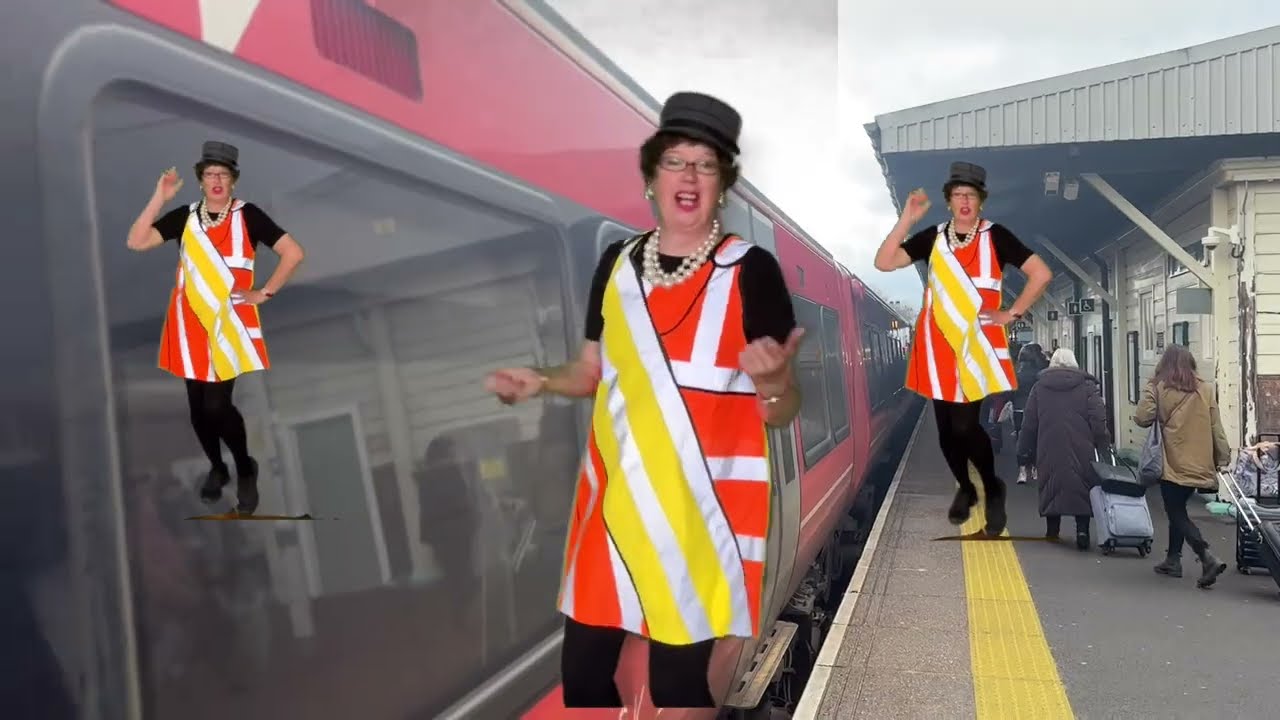
What are the chances you post this on the day i went on the train.
The experience was underwhelming, it was nice train but in times it was quite rocky.
Some concerns for me:
Being stuck behind suburban trains for 30-40 minutes of the journey (should’ve built a third track during the shutdown/occupancy)
Speed restrictions under the designed track speed for this class (it took nearly 3 hours to get down and another 3 to come back, it is 167km and should go 130kph, so it should only take just over 1 hour, maybe 90 minutes)
Connecting services at destinations, we were told that TransWA and Transregional/Transperth don’t communicate when services are delayed.
Passengers queuing to order food prior to the buffet cart opening (yes they couldn’t wait for 3 hours to not eat/drink), staff onboard just sat idly by whilst they blocked the corridor, which we had a man using a wheelchair.
It will be interesting to see how they go when the other three units commence service, frequency and duration of service.
Biggest opportunity would be the frequency and speed, it could be marketed as the quickest and easiest way to get down south.
With four units, with the speeds they can run at, the service could run every hour, with some space for layover at each end.
Certainly these things could always be faster and more frequent. Having said that, the timetable shows it is a 2hr 30 min trip (assuming it can maintain it). Google maps shows a direct trip driving is about 2 hrs. If you more closely follow the route of the line slightly inland it is more like 2hr 45 min. The replacement coach covering all stations is 45 mins longer than the train. So I would certainly say it is at least competitive even though it could be a bit quicker. 2hrs would be a good aim - considering you ideally would still be serving all the intermediate stations outside the metro - and would probably allow a 2 hourly frequency most of the time (and maybe a couple of hourly departures around peak times). The old Australind train was already suspended/retired when I ventured over west a couple of years ago. We did use the replacement coach service northbound Bunbury to Perth but hope to get back over there one day to try the train.
Transport NSW reports that train services on the Hunter line between Maitland and Newcastle, and on the Southern Highlands line between Campbelltown, Moss Vale and Goulburn, are also affected by the Telstra outage.
V/Line chief executive William Tieppo said communication with all regional Victorian trains had now been restored, but they would not be moving just yet.
“We are still seeing instability in that network and, until we get a really stable network, we’re not willing to take the risk and run trains until that network is fully stable.”
Update 2
V/Line says train services will remain suspended for the rest of tonight and Thursday’s morning peak.
ARTC still not running anything in NSW either it seems. Southern Highlands and Hunter line trains forecast to be replaced by buses most/all of Thursday too. The Dubbo service ran Wednesday due to UGL’s CRN apparently being unaffected, although the XPT I believe turned at Wellington due to Dubbo station being in ARTC-land..
(Slightly O/T) Extremely quiet in Sydney freight train wise at the moment after SSR’s prohibition notice and now the Telstra outage bringing ARTC’s network to a halt.
Trains will gradually return from midday, Thursday 9 July.
Delays and cancellations may continue across the day as we work to recover the full timetable.
Passengers are advised to check the V/Line website and mobile app for up-to-date information.
Travel on V/Line will be free on next Monday and Tuesday (July 13/14) to make up for this week’s stoppage.
The Victorian Government also announced today that works are now underway to install new Myki readers at 37 V/Line stations that require a paper ticket or eTicket, allowing travellers to tap on with their bank card, mobile phone or smartwatch.
Very disingenuous - and needless - comparison in that article where they claim Victoria’s regional network carries far more people than NSW’s - claiming 26 million vs less than 2. This completely ignores the fact that the vast majority - and busiest sections - of Victoria’s ‘regional’ network is actually comparable to NSW’s ‘Intercity’ network which alone carries more than all of Victoria’s V/Line network.
In fairness, it wouldn’t be hard for someone who doesn’t understand the intricacies of the railways to make that mistake, given that the intercity network is run by the long distance regional operator in Victoria, but the suburban operator in NSW. But then surely you’d wonder why the journos wouldn’t then ask why the numbers are so incredibly different?
For anybody interested in the numbers, the NSW intercity network moved over 29 million passengers in that same period. So you’d be looking at V/Line’s 26 million vs Intercity+NSW TrainLink’s 31 million.
The $15 billion Metro Tunnel, which opened late last year, started to untangle this knot by connecting the Sunbury line in the west to the Cranbourne-Pakenham line in the south-east via a new tunnel under the CBD.
The reconfiguration project would continue this concept: the Loop would be severed, turning two tunnels into new cross-city corridors connecting the Craigieburn and Upfield lines in the north to the Frankston and Glen Waverley lines in the south-east and east.