That would be great, thanks! 
Just to show you what it looks like here, on one of our national muxes, the location data to show the codes on the map comes from what’s in DABLIST -
That would be great, thanks!
Just to show you what it looks like here, on one of our national muxes, the location data to show the codes on the map comes from what’s in DABLIST -
Ok, video might explain better what I see, rather than still images…
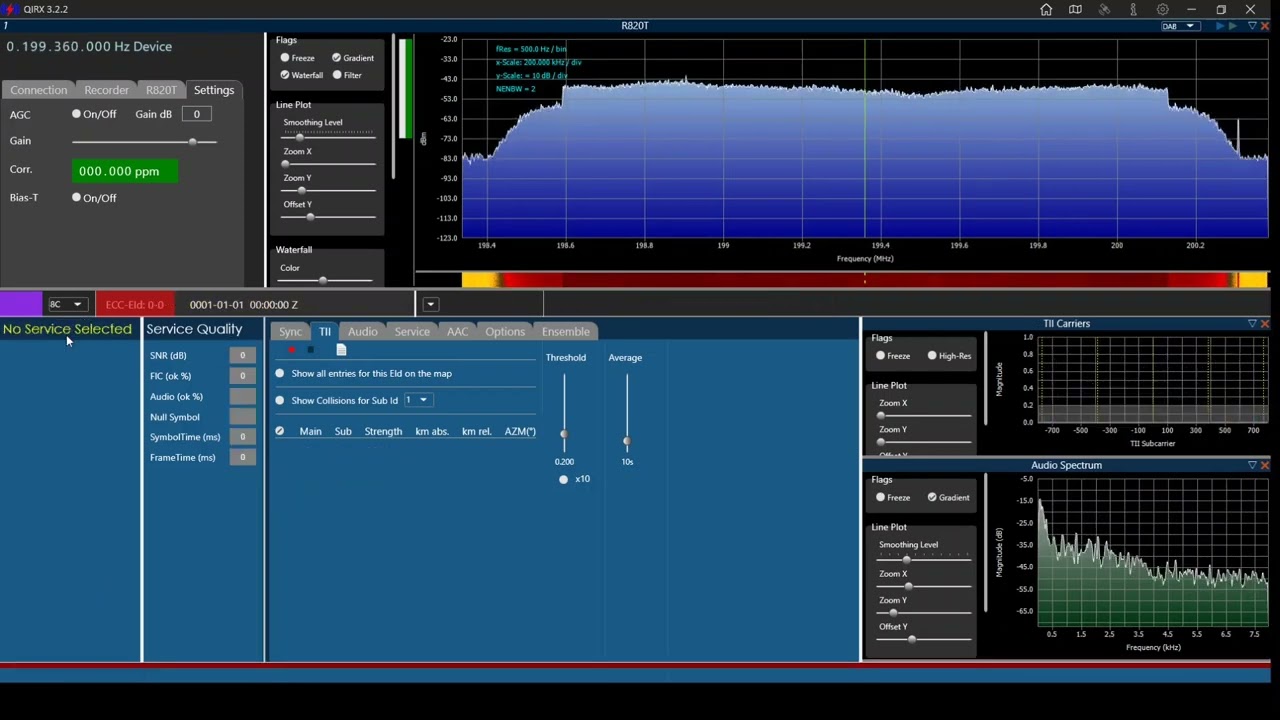
Keep in mind, I live approximately 180km from Perth, 100km from Mandurah, so my reception isn’t the greatest. There is defiantly multi-path propagation tonight on the west coast that may affect signals.
Hope this help.
Thanks for that, definitely helpful and interesting to see!
With all the random codes appearing and disappearing quickly on the Perth multiplexes, I’m pretty certain that no transmitter codes are actually being transmitted. I’ve seen this same behaviour here on some of the small-scale multiplexes we have, that also don’t transmit any TII codes.
On the other hand, you can see that the Mandurah mux is transmitting a code - the software quickly locks onto and settles on the single “0 1” value. I’ve added that to the database, so it should appear on the map now if you run “update database” under options. 
Great! Glad to make sense of what I was seeing on the 2 Perth multiplexes. I believe it has always been the case. If it changes, I’ll get in touch.
With all the issues that come with DAB+ along with the large expense, why isn’t DRM being considered, at least for regional Aust? Spectrum efficient, no third party rights, existing infrastructure can be used thus a quarter of the price, using new compression the quality is exceptional, would revolutionize the AM band not to mention more than double the services on FM, can simulcast analogue alongside digital with no extra bandwidth needed. If Government pushed it and funded the ABC, SBS and Community radio to transition thus mass ordering receivers, listeners gain extra channels. I realize this is a simplistic view (there’s numerous other factors) but seriously, why is there so much opposition to this new technology.
If you’re looking for DAB+ technical info, there’s a monitoring site with technical info, bitrates, etc. for Melbourne, Perth and other places in other countries. They also have similar info for DTT in Melbourne, Perth, and various other places in other countries as well as for some cable services, satellite services and more.
Simple: Cars don’t have DRM receivers and very few stores sell them , so without buyers it would get zero traction and would be a white elephant.
It took years for DAB to get traction, including a few outside broadcasts and annual promotions during Father’s Day etc.
I think it took at least a decade for DAB to take off, around 2018-20.
DRM would need a similar amount of investment and time but without the population to support it, it would probably only be a niche product.
It could work if enough consumers and the car industry got behind it , but it would take a lot of subsidises from the fed govt to make it work. I think it’s unlikely to happen any time soon.
I could see value in DRM being adopted to provide a ‘national emergency network’ relaying ABC Local Radio, perhaps using the longwave band which is under-utilised as it stands.
Using a network of high powered transmitters (similar to the current ABC local radio setup on AM) to cover remote areas and provide a listenable signal no matter where you are in the country, and act as a fallback in cases of bushfires, floods, storms etc. especially if local signals go down. Distribute and promote a cheap battery operated DRM radio that can be part of an emergency kit and you have a system that could potentially save lives.
Subsidies could work, sure, but it’s probably at least 5 years away as the infrastructure would need to be built first and DRM receivers imported so people can buy them from Harvey Norman or JB Hifi for example.
And the there’s the car industry, that would require carrots and possibly legislation?
That would be fine, if there’s a clear plan put in place for the rollout of this network of transmitters and associated receivers.
It wouldn’t really be designed for everyday use in vehicles, more for a situation where there’s been a natural disaster and you need information, or if you’re in a remote area with no other communications. The receiver could have an aux/USB output if you are on the road.
It’s an example of how a niche use scenario could work for DRM. The benefits of DRM in this case over conventional AM- radio text capability, very handy in an emergency to loop warnings, and with there being lots of RF interference these days, a more robust and listenable signal especially in urban areas.
With DRM, it doesn’t help that there’s not really any adoption internationally. Australia isn’t big enough of a radio market to sustain a technology on its own.
DAB+ in Australia is helped a bunch from mandates in countries like Norway and France. Think of how many standalone radios and car receivers that wouldn’t exist without Europe to sustain a market.
Even with this support, manufacturers like Sony are still pulling products out of the market.
The prime example of this is HD Radio in the US. A significantly more established technology in a much bigger market (compared to DRM). Try buying a standalone HD Radio new. You won’t find them in large retailers or from major manufacturers. HD Radio is more available in cars, but they’ve also had decades to establish that.
I don’t think it ever really ‘took off’… by the time enough cars had DAB radios to provide more choice, streaming had already overtaken it.
It took off in terms of sales of Digital radios and overall ratings and choice of DAB only stations. Streaming was also taking off but listenership of DAB only stations was huge by then, and it had become mainstream.
I agree to a point. Yet when I ask people whether they have DAB in their cars to this day I still get blank stares. Try asking 10 random people what DAB or digital radio is and what it offers, and you’ll likely be dissapointed. The industry and ACMA have not pushed it. It’s nothing like UK or Europe in terms of recognition let alone acceptance.
With DRM my main view is just that it should be opened up - auction off the spectrum and let the market decide if they can make it work.
The biggest issue for Australian DAB+ adoption was that it was exclusively existing operators, so they had no reason to care about the success of digital radio - just their success in ensuring that competition was locked out.
If we had a single ‘national’ multiplex with a free for all capacity auction to launch it, you’d have near national coverage by now - because you’d have had companies that had their success riding on making DAB work.
The same would apply to DRM - there’s companies like SEN trying to make off-band AM work, because that’s the only option for new commercial radio stations in many markets - if they had the option to go DRM they might give it a shot, same as companies like Rebel, with wide area licenses but with low cost effectiveness to cover on FM.
All that said, I think the real future of radio is extended FM. Convert the AM stations into the 76-88MHz band, and auction new frequencies in major markets. Brazil is doing it, Japan has done it in reverse. A huge number of receivers are a software change from supporting it.
3 million listeners nationally for the DAB only stations and probably another million listening to the analogue stations on DAB, is a good indicator that it has become mainstream.
The industry did push it with the OBs , Father’s Day promotions and iRiver promotion back in 2009/10.
Yes, they could do more with a regional rollout but this is largely due to the fed govt’s not planning for it or subsiding it. It’s been left to the broadcasters themselves to do it, and so far only Mandurah and the Gold Coast have begun broadcasting, outside the capitals. Hopefully Launceston will be soon.
Where did you get the 3 million figure from?
I looked at the ‘DAB Only’ cumes in the last survey and across the 5 metros, the ‘total’ cumulative audience is 3.489 million… BUT… it’s extremely likely some/many have listened to more than 1 of those stations, meaning that they would be at least double/triple counted if you are trying to work out what % of the population listens to DAB.
Exactly. I don’t believe 3 million for a second.
Correct but everyone wants the Commonwealth to pay for the infrastructure which just isn’t going to happen. It also doesn’t help that in regional areas the DAB+ would likely have to use Broadcast Australia’s Class B sites which are a monopoly in many locations such as national parks, where a competitor would never get permission to build a second site. BA are always going to give monopoly pricing. ABC have stated they want to get out of the non-ionising radiation business within the next 5 years(ie bye-bye BA) so it looks stalled there unless someone else pays. Commercial operators like SCA and ARN are putting all their eggs in online like iHeartRadio and Listnr not DAB+. All high risk stuff.
Hello. Fascinating thread.
If it’s interesting/useful: in the UK, space is reserved on local multiplexes for the BBC Local Radio station. There is a pricing model built-in to the legislation, so the BBC pays the same as everyone else (at the time of the multiplex’s launch). That allows the BBC’s national multiplex to be a full SFN that carries national programming; and BBC local radio to be carried on local multiplexes.
That model could work for the ABC here, with the exception that the ABC would need to run a state-wide model, given content differences and timezones. So, in my neck of the woods, ABC Radio Brisbane would be put onto a commercial radio multiplex, and similar for ABC Radio Gold Coast; and then “ABC/SBS Brisbane” could become a proper SFN covering South East Queensland. That has obvious benefits for frequency use, since the same frequency would be used everywhere - and thus would cut costs for transmission, since you could probably avoid doubling up coverage in south Brisbane/north GC. The UK model has some little trip hazards - not least, SFN DAB transmitters more than XXXX km apart interfere with each other - but it would seem the most sensible option. I fully appreciate that it needs a change in the law; and that there’s no space.
In terms of listening numbers - I don’t know why the CRA reports platform splits for online streaming but not for DAB; but it’s a little misleading. It isn’t particularly well-known that DAB listening (in terms of share) remains significantly higher than online streaming - and that’s in spite of every radio station promoting LiSTNR/iHeart/Listen every second of every day, and not once mentioning DAB. It’s significantly more popular than anyone realises - because the only DAB figures that are released are for the DAB-only stations (which do much, much worse than simulcasts of the main stations).
